

Artificial intelligence has quickly become part of everyday life, including mental health.
Today, many people use AI to process relationship conflicts, practice difficult conversations, or learn about their attachment styles.
It’s not hard to understand why. Therapy can feel intimidating. Cost, schedules, wait lists, and fear of judgment often prevent people from reaching out for support. AI, on the other hand, is available at any hour of the day and the response is immediate.
The longer answer is more nuanced. In this article, “AI therapy” refers to using conversational AI tools like ChatGPT or other mental health chatbots for emotional support, self-reflection, or guidance. It’s important to note that these tools are not therapists accountable to State Licensing Boards that provide legal and ethical oversight. And yet, AI can offer meaningful support and works best as a complement to therapy, rather than a replacement. Healing ultimately depends on something AI cannot yet provide: the authentic human connection that makes good couples therapy so transformative.
Why AI Feels So Helpful
Modern AI algorithms are intentionally designed to come across as warm, thoughtful, and emotionally responsive. Because they mimic human conversation so well, it’s easy to feel as though it truly understands your experience, even though no shared human experience exists. It’s still remarkably difficult for humans to comprehend how powerful, effective and clever these algorithms are.
Unlike a therapist’s office, AI is available 24 hours a day. Whether someone is overwhelmed after an argument or wants to vent after a difficult day, they can receive an immediate response without spending time or money. It’s downright intoxicating!
Many people also appreciate what feels like a shame-free environment – because AI offers the illusion of emotional safety and zero judgment. And unlike humans, it doesn’t get tired, impatient or critical.
AI does a great job as a sounding board. It helps organize scattered thoughts, summarizes complex emotions, and explains psychological concepts in ways that are easy to understand.
In many ways, AI lowers the financial and practical barriers that often prevent people from going to traditional therapy in the first place.
What AI Actually Does Well
Despite any limitations, AI has genuine strengths. When used thoughtfully, it can support the therapeutic process in meaningful ways. It provides language, summaries, and lots of suggestions. AI can be a useful tool for self-reflection and insights.
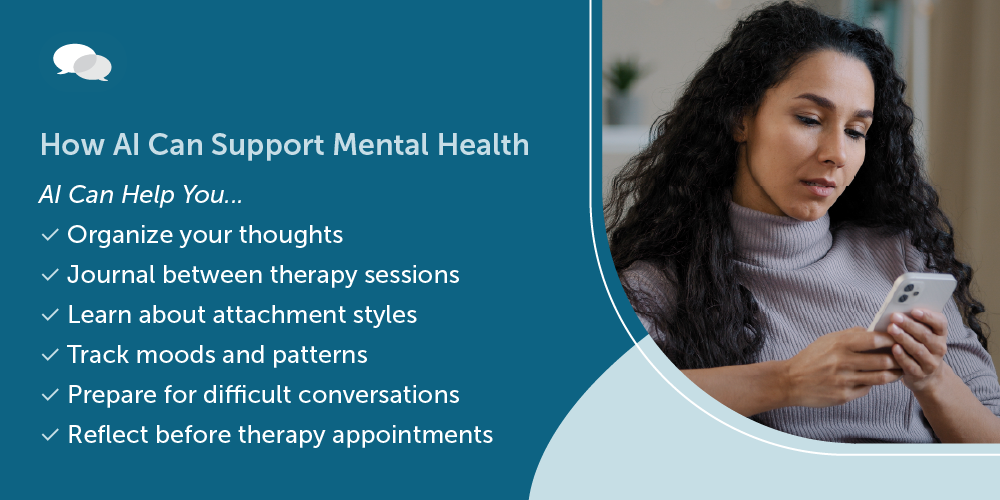
One of its greatest strengths is helping people organize their thoughts. Journaling exercises, mood tracking, and guided reflection can help someone make sense of overwhelming emotions before they become too difficult to process.
AI is also particularly effective at structured tasks. It can help identify patterns in thinking, point out possible cognitive distortions, explain attachment theory, and introduce evidence-based relationship concepts in an easy-to-understand way.
For example, someone might use AI to learn about attachment styles, explore why certain relationship patterns keep repeating, and even prepare for a difficult conversation with their partner before having it in real life.
The information and insights AI provides are great and valuable starting points.
Insight creates awareness. Therapy helps people integrate that awareness into everyday relationships, emotions, and behaviors.
Where AI Begins to Fall Short
Understanding something intellectually is very different from a human experience that creates lasting emotional change.
This is where AI therapy begins to reach its limits.
Imagine someone spends hours researching attachment theory and uses AI to prepare for an important conversation with their partner. They carefully follow the suggested script and feel well-prepared for their partner’s response. But the conversation doesn’t go as expected.
Their partner misunderstands what they’re trying to say, or responds in a completely unexpected way. Suddenly, the carefully planned script no longer fits the situation, leaving the person feeling discouraged or even more confused than before they started.
Real relationships simply don’t follow the predictable patterns we expect.
They are emotional, messy, and full of misunderstandings that cannot be anticipated.
While AI can explain communication strategies and relationship theories, it cannot recreate the lived experience of navigating and walking around in another person’s emotions.
The Biggest Risks of Relying on AI for Emotional Support
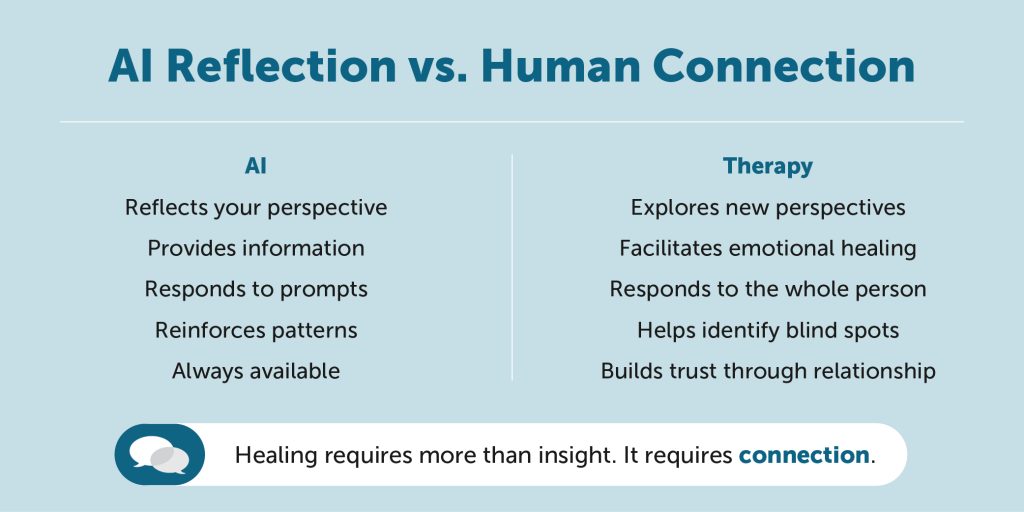
Another challenge is that AI often functions more like a mirror than a therapist.
Because AI is designed to respond in ways that feel helpful and agreeable, it may unintentionally reinforce the user’s existing beliefs instead of gently challenging them. In some cases, it can become an echo chamber that reflects someone’s perspective back to them without identifying blind spots or defensive behaviors.
A trained therapist does much more than validate emotions. They help clients recognize patterns they may not see on their own, ask thoughtful questions, and introduce healthy discussions that encourage growth.
AI cannot consistently provide that kind of therapeutic friction.
AI has also become increasingly conversational. It’s important to note that these systems are designed to mimic empathy and human dialogue so effectively, some users begin forming strong emotional attachments to them.
Unlike real relationships, AI never has a bad day, never misreads your tone, or asks you to repair a misunderstanding with an apology. What can feel comforting also removes the very experiences that help us grow emotionally.
The line between technology and intimacy has started to blur, creating the feeling of a relationship without the mutual vulnerability and reciprocity that define real human connection.
Why Human Connection Is Still Essential for Our Healing
While AI can provide information, healing happens through human connection.
Human beings are wired for relationship. Our nervous systems naturally respond to one another through a process called co-regulation. A calm voice, a compassionate facial expression, or even a shared moment of silence can help someone feel safe enough to process difficult emotions.
While we may try our best…and want it to be different, these experiences cannot be replicated through text on a screen.
Tone of voice, facial expression, and genuine presence matter.
The relationship and trust built between the therapist and a client…and their partner….are a critical component of healing. Feeling truly seen, accepted, and understood creates the safety needed for emotional growth.
This is especially true in Emotionally Focused Therapy (EFT), where healing happens through safe emotional connection, rather than simply learning new information.
Emotionally Focused Therapy helps people move beyond simply understanding their emotions to experiencing new patterns of connection and safety within their relationships.
Can AI Ever Replace a Licensed Therapist?
So, can AI replace therapy?
For now, the answer is no.
AI will almost certainly continue becoming more sophisticated. It may become better at recognizing patterns, explaining psychological concepts, and generating increasingly natural conversations.
But calculation isn’t consciousness.
Pattern recognition isn’t lived experience.
A machine can simulate empathy, but it can’t actually share human experiences like grief, heartbreak, love, or even a warm hug. At least not yet.
AI can also make someone think that learning the right vocabulary or communication techniques is the equivalent of therapy. And, while those tools are helpful, knowing the language of healing isn’t the same as experiencing an emotional exchange with another person.
True therapy is about much more than exchanging information. At its core, healing is a relational experience built on trust, empathy, and authentic human connection.
Those qualities remain uniquely human.
How Do You Know When AI Isn’t Enough?
AI can be a helpful place to start, but there are times when additional support is needed. For example:
- You understand your attachment style, yet still feel stuck in the same relationship patterns.
- Your relationships aren’t improving despite doing lots of reading about communication, anxiety, or trauma.
- You’re becoming increasingly anxious or disconnected, even though you’ve gained plenty of insight.
- You begin to cope by building more boundaries and walls to protect yourself, but this ends up creating even more isolation and loneliness.
- You begin to realize you’re having the same conversations with AI over and over without experiencing meaningful change.
Understanding insights and theories can be valuable, but healing comes through integrating those insights into real relationships, where conversations rarely unfold according to a script.
Insight is important, but insight alone doesn’t create healing.
When understanding isn’t translating into a deeper connection, it may be time to speak to a therapist.
Using AI as a Tool, Not a Replacement
The good news is that AI and therapy don’t have to compete with one another.
AI can be an excellent companion to therapy when it’s used intentionally.
It can help you journal between sessions, organize your thoughts before an appointment, track moods, explore psychological concepts, or prepare questions for your next session.
Many people find it helpful to bring those reflections into therapy by saying something like, “I spent some time reflecting on this with AI this week. Can we unpack it together?”
Used this way, AI becomes a tool that supports the therapeutic process rather than replacing it.
Instead of standing in for human connection, it helps prepare people to engage more fully in it.
Feed Your Brain, Heal Your Heart
AI has transformed the way people access information about mental health, relationships, and personal growth. Used thoughtfully, it can increase self-awareness, encourage reflection, and make psychological concepts more approachable.
But healing involves more than understanding yourself.
It involves being seen, accepted, challenged, and supported by another person. It happens through conversations that don’t follow a script, through moments of repair after misunderstanding, and through relationships built on trust and genuine emotional presence.
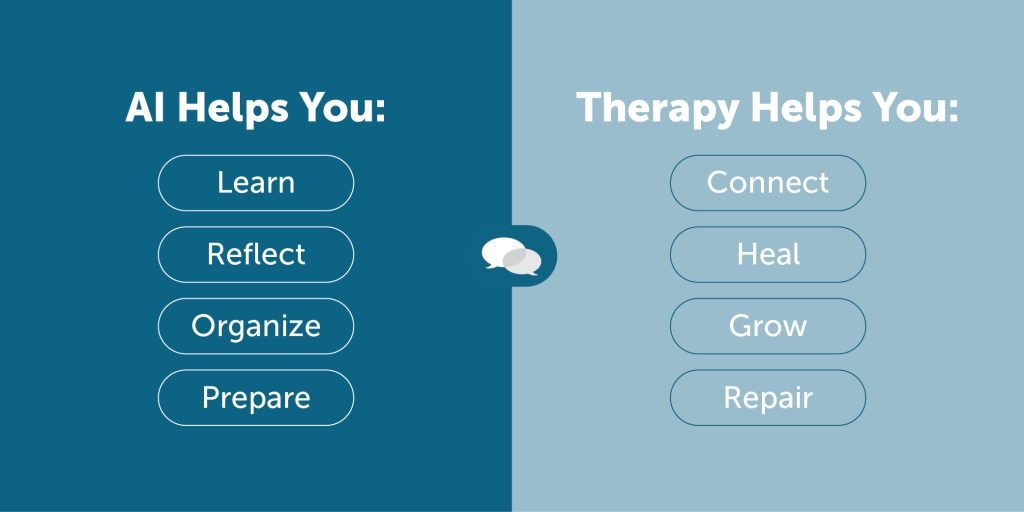
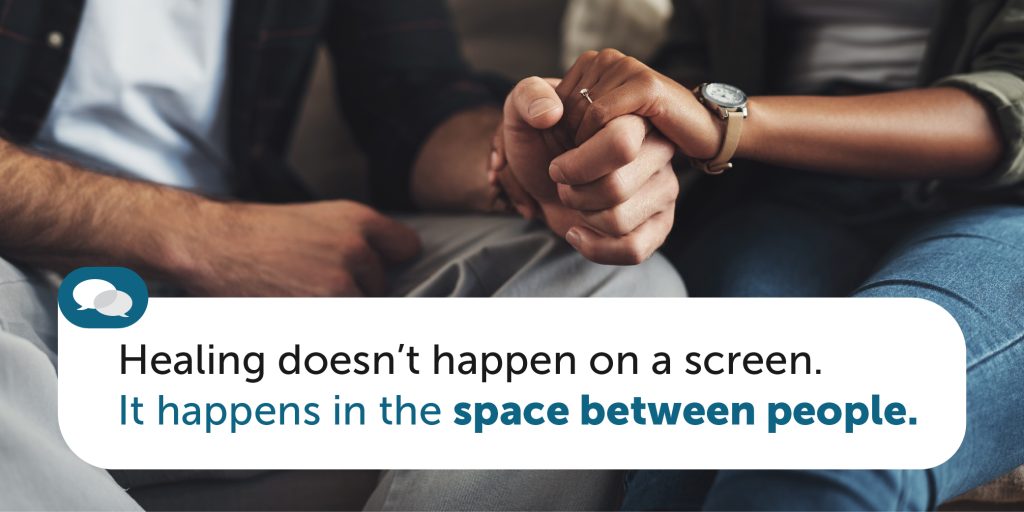
AI can help organize your thoughts and deepen your understanding. Use it to feed your brain and prepare for meaningful conversations. But healing doesn’t happen in isolation or on a screen. It happens in the space between people, through relationships built on trust, empathy, vulnerability, and repair. Step into the therapy room to heal your heart.
Insight starts the journey. Human connection creates lasting change.


