

A couple once sat in my office.
Their body language was stiff. The air between them was loaded with tension. They had a hard time looking at each other as we sat down. When I asked what brought them to therapy, the wife hesitated before she softly said, “We’re not sure there’s anything left to save.” Her husband nodded silently.
This isn’t an uncommon start to the stories I hear. Relationships face crises every day — whether it’s a betrayal of trust, an ongoing argument that seems to have no end, or the stress of outside factors like work or health.
These issues can make you feel like the ground beneath you is crumbling. But, there is always hope.
Relationship distress is everywhere and far more common than most people realize. While it might feel like your relationship is unique in its problems, you’ll find that couples all over the world are grappling with their own versions of the same story.
No crisis has to be the final chapter. If you’re ready to begin the process of healing, Wellness has a team of extraordinary therapists who are here to help guide the way. Let’s begin.
Recognizing a Relationship in Distress
Have you ever heard the phrase, “It isn’t the mountains ahead to climb that wear us out; it’s the pebble in our shoe”? In relationships, it’s often the little things that are left unresolved that pile up and create the biggest challenges.
In a highly distressed relationship, every little thing seems to be a problem. Those little things can become big sources of frustration when there are so many unresolved issues that go addressed.
Key Indicators of Trouble
Some signs of trouble are loud and unmistakable, while others linger in the background. They’re barely noticeable until they’ve built up enough power to cause a whirlwind of emotions. Here’s what to watch for:
- Recurring, unresolved arguments: The biggest red flag for a relationship in distress is a recurring argument. Maybe it’s about finances, parenting, or even whose turn it is to take out the trash. The topic doesn’t matter as much as the pattern — if the same arguments keep circling back without resolution, pay attention. It’s a red flag.
- Everyday irritations that escalate into larger issues: Maybe you used to find your partner’s quirks endearing, but now, even the way they approach ordinary life can feel like a personal attack. We all get annoyed with one another sometimes, but if those small annoyances grow into disproportionately large conflicts, there’s usually an underlying issue that’s been unaddressed for too long.
- Stress, unhappiness, and volatility: Do you feel like you’re walking on eggshells? When tension fills the air and negative emotions take over, it’s a telltale sign that your relationship is saying, “Hey, we need some attention here!”
The Domino Effect of Unresolved Issues
Here’s the odd thing about unresolved relationship issues: they don’t just sit quietly in the corner. They grow roots, creep into other areas of your life, and affect how you interact with your partner on a day-to-day basis.
That disagreement over spending habits might start as a small spark — maybe a side comment during breakfast — but it doesn’t always stop there. By dinnertime, it could be simmering into frustration and then boil over into who left the dishes in the sink. By bedtime, it’s a cold shoulder instead of a goodnight kiss.
Sound familiar? If so, just know, it’s rarely about the dishes or the budget; more likely it’s about the deeper emotions lurking beneath the surface. And when those unresolved problems fester, they don’t just stay in your relationship. They have a sneaky way of showing up in other areas of your life, too.
This is one of the major reasons many people experience anxiety, depression, or even physical health problems. Our everyday frustrations, physical health, and emotional health are all connected. When your mental well-being takes a hit, it becomes that much harder to show up in your relationship with the patience, compassion, and kindness it deserves.
And, just like one unresolved issue can snowball into bigger problems, one small gesture of effort can spark a positive domino effect. Something as simple as starting an honest conversation or even admitting, “We’re not okay right now,” can be the first step in turning things around.
So, if you’re reading this and it strikes a chord, you’re already on the path to healing. Recognizing the signs is half the battle, and from here, it’s about taking those next steps — together. Let’s keep going. The best is yet to come.
How We Interpret Actions in a Distressed Relationship
I’m always fascinated by how two people can look at the same situation and walk away with completely different stories.
When we’re already hurt or frustrated, we tend to interpret even the smallest actions through a lens of hurt or frustration, turning a simple mistake into an all-out battle. It’s amazing how quickly the tiniest thing can feel like a major blow when we’re already on edge.
The Role of Perception
Let’s talk about socks for a moment — yes, socks.
Imagine your partner leaves their socks on the floor again after you’ve asked (and asked) them to pick them up. To them, it might be an oversight, a harmless habit they don’t even think about. But to you, it feels like a loud and clear message, “I don’t respect you or your efforts!”
This is how perception shows up in a strained relationship. Small actions, ones that normally would’ve been shrugged off during happier times, start to sting. Why? Because when trust or emotional safety is shaky, we’re more likely to view our partner’s behaviors as intentional or hurtful, even when they aren’t.
And it’s not just the actions themselves; it’s the deeper context. If you’re feeling unappreciated or unsupported, even neutral behaviors can take on a negative spin.
The Importance of Communication
Misinterpretations are like little seeds — harmless at first, but when left unchecked, they can grow into full-blown weeds that choke out all the healthy parts of your relationship. That’s why communication is your lifeline.
When something feels off, don’t let it fester. Address it early so you can stop an avalanche of misunderstandings before it even starts. Instead of assuming your partner left their socks on the floor because they just don’t care, try saying, “Hey, can we talk about why this keeps happening? It’s starting to feel like a bigger deal to me than it might seem to you and I don’t understand why it upsets me so much.”
Effective communication is about approaching conflict with curiosity, not blame. When you open up about how you’re feeling and attach it to the meaning you make.….well that’s when you give your partner the chance to understand and adjust. And in that moment, you’re reminding each other that you’re on the same team.
The Delay in Seeking Help
Research shows that most couples who seek therapy wait an average of six (6) years before seeking help for serious relationship problems. Six years!
Imagine breaking your toe and waiting that long to see a doctor. By the time you get treatment, you’re not just dealing with a broken bone — you’re dealing with some serious complications that could’ve been avoided entirely!
Statistics and Stigma
The reason so many couples avoid seeking outside help often comes down to one word: stigma.
Despite growing acceptance and awareness, therapy is still too often seen as a last resort, rather than a proactive step. Some couples view marriage counseling as an admission of failure while others worry about being judged or misunderstood. And let’s not forget the classic “we’re smart and ought to be able to figure it out ourselves”.
Unfortunately waiting to address relationship issues doesn’t make them magically disappear. Unresolved conflicts, unmet needs, and lingering resentments don’t just vanish — they build up, like an unattended leak that eventually floods the whole basement.
The sooner partners face them together, the easier the healing process is likely to be. So, why wait?
Normalizing Couples Counseling
You have the power to flip the script.
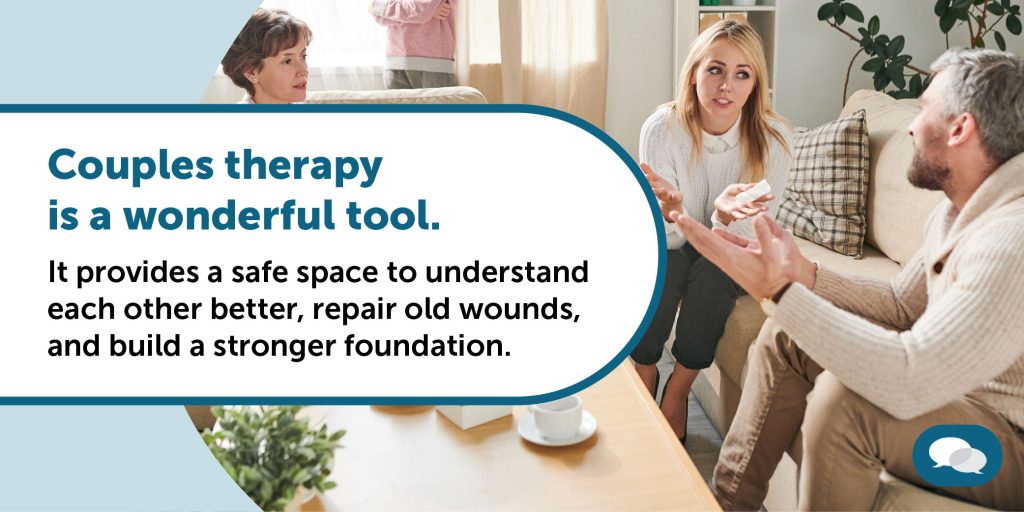
Therapy isn’t a sign your relationship is broken. Rather, it’s a sign that you and your partner are invested in making it stronger, together. Now, that’s powerful.
Think of counseling as self-care for your relationship. You get regular checkups for your physical health and maintenance for your car, right? The same should go for your relationship. Couples therapy is about proactively making sure your relationship stays healthy and stands the test of time.
Life Happens: The Reality of Long-Term Relationships
No matter how deeply you love each other, life always has a way of throwing challenges your way.
Job losses, illnesses, the death of loved ones — these are the inevitable storms that come with being human. When those storms hit and your relationship goes sideways, it’s easy to think your relationship is failing. Let me assure you: challenges are not the same as failures.
Every relationship goes through tough seasons. So, when struggles arise, please don’t see them as a reflection of your relationship’s worth. Consider them bumps in the road, challenges to navigate together.
Problem-Solving Together
The beauty of long-term relationships is that you don’t have to face life’s challenges alone. When you approach problems as a team, something amazing happens: Problems stop feeling like insurmountable mountains and start looking more like opportunities to grow closer, deepen your understanding of each other, and build resilience together.
It’s not about avoiding life’s inevitable bumps. It’s about going through challenges side by side, hand in hand. That’s where the true strength of a relationship lies: in the way you hold each other up through life’s highs and lows.
The Path to Repair
There’s a common misconception that once a relationship is “broken,” it’s beyond saving. But I’ve seen countless couples who thought they were at the end of the road and they managed to rebuild something even stronger than they had before.
Repair is very much possible when both people are willing..
The Role of Therapy
Therapy is a major part of a couple’s healing journey. The earlier you seek couples counseling, the smoother the repair process tends to be.
The ideal scenario is when both partners are equally committed to the journey of healing and repair. But life isn’t always ideal. Even if one partner is hesitant or unsure, therapy can still open doors to understanding and healing. No matter where you start, therapy can help you get to a better place.
Hope and Possibility
One of the most remarkable aspects of relationships is their ability to adapt and grow. Emotional connection transcends cultural differences, life circumstances, and even past mistakes. It’s a universal thread that ties us all together, making repair possible in a wide range of relationships.
I’ve worked with couples who’ve faced unimaginable hardships — infidelity, financial crises, the loss of a child — and I’ve seen them rebuild something truly profound. The common denominator? A willingness to show up, be vulnerable, and believe in the possibility of something better.
Repair isn’t always about going back to “how things used to be” either. For lots of people, it’s about creating something new, something grounded in deeper understanding and mutual respect.
The path to repair may not be easy, but it’s always worth it. So, take that first step, and know that something better is waiting for you on the other side.
The Road to Renewal
Finally, the message I’d like to leave you with: No matter how tough things may seem, don’t give up. Repair is possible.
If you’re struggling to open up and communicate, you’re not alone. The good news is that we have more resources than ever to help you repair and rebuild.
If you’re ready to create a deeper connection with your partner, we’re here for you. Reach out to us today to learn more about our marriage counseling services, or join us for our Couples Retreats in North Carolina. Together, we’ll help you reconnect and transform your relationship from the inside out.


