

Most of us are harder on ourselves than we realize.
There is often a quiet pressure running in the background — trying to get things right, trying not to make mistakes, trying to be better. When something goes wrong, the response is fast: frustration, self-criticism, or shutting down emotionally.
Over time, that way of relating to yourself starts to feel normal. But it rarely stays internal.
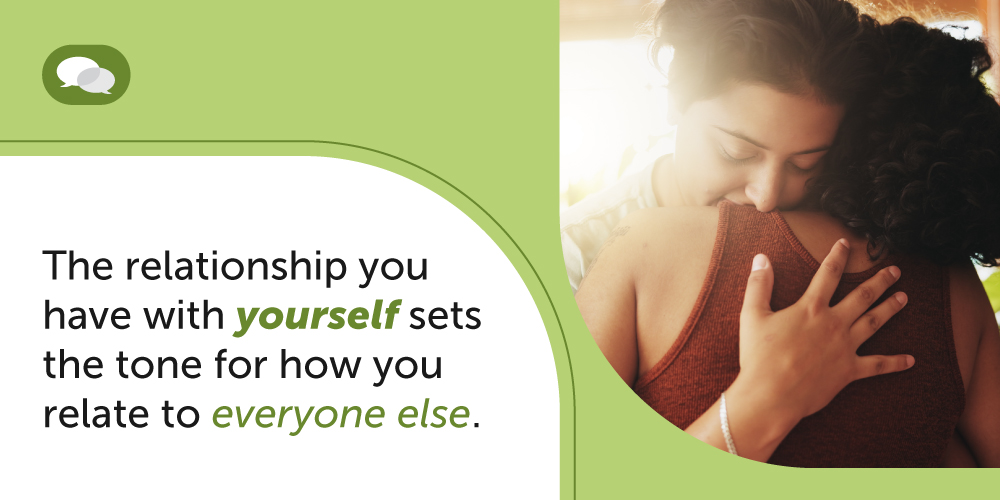
The relationship you have with yourself has a way of showing up in every other relationship in your life — with your partner, your family, the people closest to you. That’s why self-compassion isn’t just a personal wellness concept. It’s a relational one.
What Is Self-Compassion, Really?
Self-compassion isn’t about letting yourself off the hook or pretending that problems don’t matter. It’s about being able to stay with yourself when things are hard, allowing room for mistakes, releasing the pressure to get everything right, and treating yourself with the same care you’d offer a close friend.
The word kindness actually comes from the word kin, meaning connection and genuine care. When that kind of care is missing internally, it becomes difficult to offer consistently to someone else.
When there’s constant internal pressure or self-criticism, it often surfaces in relationships as:
- Impatience
- Defensiveness
- Emotional withdrawal or disconnection
This is why the relationship you have with yourself matters so much. It sets the tone for how you relate to everyone else.
Why Self-Compassion Can Be So Difficult
For many people, slowing down and being kind to themselves doesn’t come naturally. There’s often a deeply held belief that being hard on yourself is what holds things together — that if you let up, things will fall apart.
Many people, especially women, carry a strong sense of responsibility to manage everything: work, home, relationships, emotions. Underneath that can be a quiet fear of:
- Not being good enough
- Being judged by others
- Losing connection with the people who matter most
So the response becomes: try harder, do more, be better. But that usually leads to exhaustion, not peace.
Without space to pause, people tend to fall into patterns of reacting quickly, becoming defensive, or judging themselves and others harshly.
This is where learning to practice self-compassion really matters, not as something extra to add to your to-do list, but as a different way of relating to yourself in the middle of what’s already happening.
This is also what mindful self-compassion looks like in practice: simply noticing what’s happening inside you, without immediately trying to fix it or push it away.
From Reactivity to Regulation: What’s Actually Happening
When emotions become intense, it’s hard to stay grounded. In those moments, people tend to react rather than respond.
That might look like attacking (“You never show up for me”), becoming defensive, or withdrawing entirely. When this happens, connection breaks down.
Communication becomes clouded, and it becomes harder to stay in touch with what you actually need.
Often, what people want most in those moments is comfort and closeness, but it can feel risky to ask for it, or difficult to receive when it’s offered. Because of this, couples frequently miss each other in the moments that matter most.
This is one of the most meaningful benefits of self-compassion: it creates a pause.
That shift begins internally — pausing, observing what’s happening inside you, and allowing a moment of space before responding.
From there, it becomes possible to communicate in a way that’s clear, honest, and connected.
Practical Self-Compassion Tools for Emotional Regulation
This work doesn’t have to be complicated, but it does need to be intentional. Here are some simple self-compassion practices worth returning to:
Breathing
Slow, deep breaths help regulate your nervous system. Even pausing to count to ten can interrupt a reactive cycle before it escalates.
Stillness
Before responding, allow yourself a moment to simply sit with what you’re feeling. Stillness isn’t avoidance. It’s a doorway to a more thoughtful response.
Observation
Check in with yourself: Am I overwhelmed right now? Am I hurt? Am I tense? Naming what’s happening internally is one of the most grounding things you can do.
Touch
When connection with your partner feels difficult, small acts of self-soothing can help regulate your nervous system. Placing a hand over your heart or holding your own arms can create a genuine sense of calm.
Clear Expression
Once you have a little more regulation, it becomes easier to say:
- “I need a moment.”
- “I’m feeling overwhelmed right now.”
- “I need some support.”
These may feel like small shifts, but they move you from reacting automatically to responding with awareness. In distressed relationships, this kind of communication is often missing. It’s also where healing begins.
The Foundation Most People Overlook
Emotional regulation isn’t just mental. It’s also physical. When your basic needs aren’t being met, everything becomes harder.
Sleep, hydration, nutrition, and movement all affect how you feel and how you respond to the people around you. Without them, your capacity for patience, empathy, and self-regulation decreases.
Caring for your body isn’t a luxury. It’s a non-negotiable part of self-compassion. Ignoring those needs is often normalized, especially when life is full and busy, but over time, it adds a strain that shows up in your closest relationships.
Redefining Kindness, Self-Compassion, and Strength
Kindness is often misunderstood. It’s not the same as being agreeable, avoiding conflict, or keeping everything smooth. Kindness is rooted in genuine care, and it includes honesty, truth, and a willingness to show up in a way that actually supports connection.
Self-compassion reflects that same kind of care, directed inward. It looks like:
- Allowing yourself to make mistakes without spiraling into shame
- Releasing the pressure to perform or appear as though everything is fine
- Offering yourself the same forgiveness you’d extend to someone you love
Self-compassion doesn’t lower your standards. It shifts how you relate to yourself while you grow, and that’s where real strength lives.
The Ongoing Practice — and the Ripple Effect
This isn’t a one-time shift. Learning to practice self-compassion is ongoing work. There will still be moments of reactivity, frustration, and self-criticism.
But with intentional practice, something begins to change:
- Self-compassion supports emotional regulation
- Emotional regulation supports clearer communication
- Clearer communication supports healthier, more connected relationships
The relationship you have with yourself doesn’t stay internal. It shapes how you show up with the people you love — how you communicate, how you repair after conflict, and how you stay connected in the moments that matter.
You Don’t Have to Figure This Out Alone
If you’re looking to improve your relationships, this inner work is often where it begins. And it’s something you can build with support, guidance, and time.
At Wellness Counseling Center, our therapists use Emotionally Focused Therapy (EFT) to help individuals and couples understand the patterns beneath their reactions, build emotional safety, and reconnect with the people they care about most. You can also explore additional tools and resources here.
If you’re ready to explore what this work could look like for you, we’d love to connect. Reach out today for a free consultation.


