

If you’ve been in a relationship for any length of time, chances are you’ve heard of The 5 Love Languages®. The concept was introduced by Dr. Gary Chapman, who suggests that people primarily give and receive love in one of five ways:
- Words of affirmation
- Acts of service
- Receiving gifts
- Quality time
- Physical touch
At first glance, it makes a lot of sense, doesn’t it? If you know your partner thrives on words of affirmation, telling them “I appreciate you” should strengthen the relationship, right?
Well … yes and no.
The Love Languages framework can be a helpful tool, but it has its limits — especially when a relationship is in distress.
In fact, when emotions are running high and past wounds are still fresh, trying to “speak” your partner’s love language can sometimes backfire.
Even a well-intended gesture can be misinterpreted — “They’re only doing this because I asked a hundred times. It doesn’t even mean anything!” Rather than fostering connection, it can lead to frustration and resentment.
This is where Emotionally Focused Therapy (EFT) comes in. While love languages focus on “doing” certain tasks to show love, EFT dives deeper into the emotional connection. It helps couples understand the emotions, experiences, and unspoken feelings that shape their bond.
If love languages are the “what,” EFT is the “why.” It’s the difference between following a script and truly understanding the story. And when couples feel disconnected, that difference can make all the impact.
Why Love Languages Can Be Difficult in a Relationship Crisis
The 5 Love Languages are often praised as a simple way to strengthen relationships, but when emotions are running high, they can feel less like a helpful tool and more like a relationship report card.
What a great way to leave both partners feeling like they’re failing! Here’s what I mean by that.
Let’s say a husband, who’s trying to do the “right” thing, brings home flowers for his wife because her Love Language is gifts. But instead of feeling adored in that moment, she says, “I’ve told you a hundred times that I like daffodils, not roses.”
In his mind, he was making an honest effort. In her mind, he wasn’t really paying attention to her wants and needs. Now, he’s thinking, “Why even bother?” and she feels misunderstood.
Suddenly, the gesture that was meant to bring them closer has pushed them even further apart. This is what happens when we treat Love Languages as a fix rather than a foundation.
Beyond that, Love Languages tend to box people in. They assign specific labels — “He likes acts of service, she likes gifts and words of affirmation” — but don’t allow much room for flexibility or grace. Both of these are essential for a long-lasting, fulfilling relationship.
When couples are already struggling, feeling the pressure to “perform” a specific love language can actually increase stress rather than strengthen the connection.
The Power of EFT: Understanding Meaning-Making in Relationships
If Love Languages are about what we do, EFT is about why it matters. This is why EFT is so powerful. Instead of focusing on what happened, it helps couples explore why it felt that way.
It shifts the conversation from, “You never listen. I told you I like daffodils,” to, “When I see roses instead of daffodils, I feel like I’m not being heard. And that reminds me of how invisible I felt growing up.”
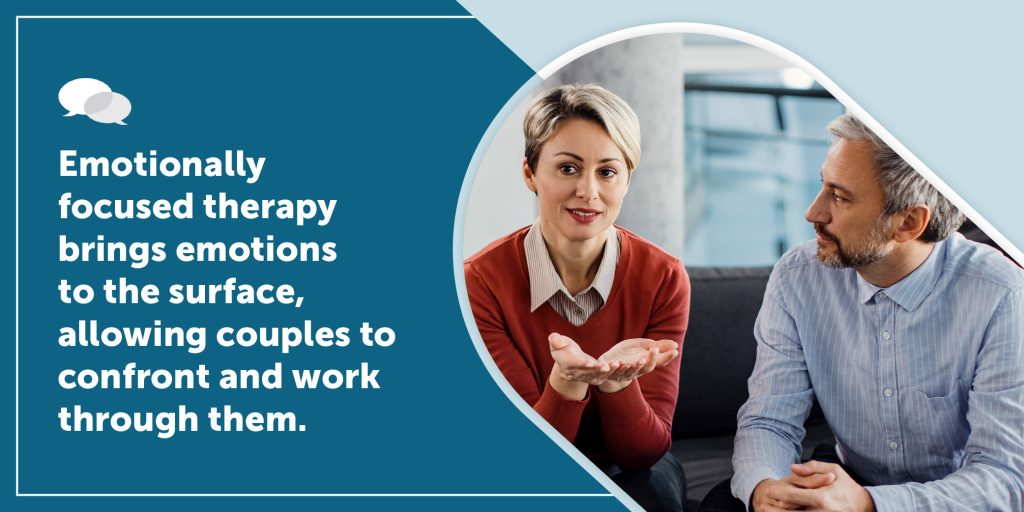
EFT brings emotions to the surface, allowing couples to confront and work through them, rather than letting them simmer beneath layers of passive-aggressive comments about things like flower choices.
It helps couples understand that their reactions aren’t just about a single moment, but reflect a deeper emotional history that’s built up over time.
The real magic of EFT is that when couples begin to grasp the true meaning behind each other’s actions, they stop keeping score, stop misinterpreting intentions, and start seeing each other in a whole new light. I’m not sure a love language quiz could achieve all of that!
EFT vs Love Languages: Addressing the Root of the Problem
One of the greatest strengths of EFT is its ability to address the core issues at the heart of a relationship. In contrast, the Love Languages approach often reduces emotional connection to a checklist: offer more compliments, buy more gifts, or schedule more quality time.
While these actions may seem helpful, they don’t always tackle the deeper emotional struggles in a relationship. Instead, they can leave couples feeling like they’re just ticking boxes, without truly resolving the underlying issues.
EFT helps couples recognize certain cycles and patterns of behavior. It’s about how couples interpret and respond to each other in ways that reinforce emotional distance. Here’s an instance you may have experienced firsthand:
- When a partner feels unheard, they pull away.
- When they pull away, the other person feels abandoned.
- When they feel abandoned, they get defensive or frustrated.
- And when they get defensive, the first partner shuts down even more.
The 5 Love Languages can’t always break that cycle, but emotionally focused therapy can.
The Importance of Experiencing EFT, Not Just Understanding It
You can read about EFT all you want. You can nod along, and think, “Yep, that makes sense.” But its true power emerges when you experience it in the moment, as emotions surface and patterns become crystal clear.

When a couple sits down to talk about a past hurt, the emotions are raw. One partner might say, “When you shut down, I feel invisible,” and for the first time, their spouse listens — not with defensiveness or dismissal, but with an open heart.
EFT doesn’t shy away from emotions. It invites them into the room, making them impossible to ignore. In that space, walls come down, old wounds resurface, and real transformation begins.
Why EFT Is the Key to Healing
Love Languages can help keep a relationship running smoothly, but EFT is what helps it heal.
If you and your partner have tried everything and still feel disconnected, EFT can help you break the cycle and rebuild your relationship on a foundation of real emotional security.
If you’re curious to see how, check out the work of Dr. Sue Johnson, the creator of EFT. I highly recommend her books, especially Hold Me Tight and Love Sense.
I’ve worked with so many couples who have felt stuck, exhausted, and unsure of what to do next. If that sounds familiar, you’re not alone — and you don’t have to figure it out on your own. That’s what we’re here for.
If you’re ready to move past frustration and find your way back to each other, reach out to us today.


